Wednesday, February 26, 2014

Loving Yosemite means many things ... like loving reliable water deliveries as well

For many of us, loving Yosemite means loving the whole park and therefore restoring Hetch Hetchy Valley to its former glory. And restoring Hetch Hetchy Valley means developing a practical water system solution for San Francisco and its Bay Area customers. So Restore Hetch Hetchy loves a reliable water system as well.

We have always emphasized that San Francisco can and should continue diversions of high quality Tuolumne River water. We just don't want the city to store the water within the boundaries of Yosemite. Analysis shows that 95% of the Tuolumne River supplies now diverted to San Francisco would still be available after Hetch Hetchy Valley is restored.  
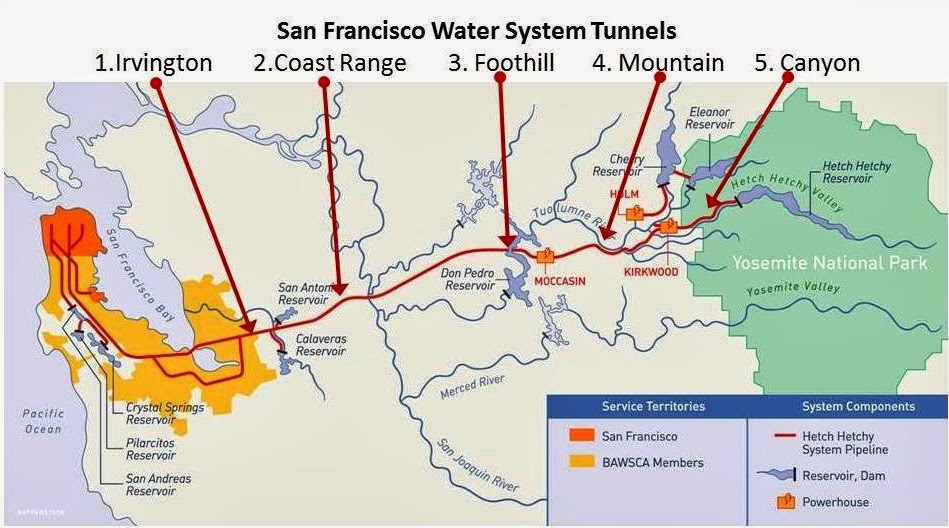
So we are scratching our heads over the recent news that another critical piece of San Francisco's infrastructure is at risk. As the SF Examiner reports, the Mountain Tunnel could collapse and is in need of a $M 628 repair. The Mountain Tunnel is just one of five principal tunnels through which Tuolumne River diversions flow enroute from the Sierra to the Bay Area (see diagram). 

Restore Hetch Hetchy supports repair of this critical infrastructure - as we did a decade ago when the Irvington Tunnel was shown to be at risk.  But we also question whether this latest revelation is yet another reason why San Francisco (as well as other urban communities) should question the wisdom of relying on a single remote source for the majority of its water. Last summer's "Rim Fire" made us ask the same question.

Diversity is reliability. Water systems of the future will increasingly develop local supplies - by better managing groundwater, recycling wastewater, capturing storm water and storing supplies closer to their customers.

We hope San Francisco will soon support restoration of Yosemite's Hetch Hetchy Valley, and will diversify its system as well to increase reliability. But meanwhile, we support a timely and cost-effective solution to the problems with the Mountain Tunnel.


Spreck Rosekrans is Executive Director of Restore Hetch Hetchy   

Sunday, February 9, 2014

Day hikes into the Grand Canyon of the Tuolumne?

Yesterday’s Water Law Symposium at UC Hastings in San Francisco included a session titled “The Hetch Hetchy Controversy”. The session included good questions and a few strong opinions on both sides from the audience, as well as some of the usual repartee between Restore Hetch Hetchy and the San Francisco Public Utilities Commission (SFPUC).

One young man asked whether we wanted to create “another Yosemite Valley”. By the way he asked the question, he was asking if we envisioned a restoration plan with the infrastructure, crowds and traffic jams that can be overwhelming in Yosemite Valley.

I responded that Restore Hetch Hetchy does not have a definitive plan for how the valley should be managed once it is restored – that is something for the public and National Park Service to work out. I pointed out, however, that the Park Service has allowed little development in Denali, a more recently established national park.

I did say that I could imagine a Hetch Hetchy Valley that did not allow the private automobile, but which included an efficient shuttle system (light rail, bus, or tram) that would transport visitors to the upper end of the valley. I explained that such a shuttle system would allow day hikes into the Grand Canyon of the Tuolumne – a spectacular area that lies upstream of the current reservoir. Presently the only way to see the Tuolumne’s “Grand Canyon” is to do a multi-day backpack trip.

The SFPUC representative opined that allowing day use of the Grand Canyon of the Tuolumne would ruin it. (He further opined that the reservoir is protecting the valley – something we have heard before.)

What do supporters of restoration think about how the Park Service should manage a restored valley? How should people get to the upstream end of the valley? Should there be roads? If so, what about the private automobile? How about paved paths for bicycles and wheelchairs?

And should a restored valley include campgrounds or other lodging? Where should these be?

If Yosemite Valley accommodates 4,000,000 people a year, what is the right vision for Hetch Hetchy Valley? Bear in mind that both are about nine miles long but Yosemite Valley is wider.

How do we restore a valley so it can be loved but not loved to death?

Please share any thought you have on these matters below. Right now the discussion is just for fun. It will be more serious, and more exciting, once plans to remove the reservoir are in place.

Friday, January 17, 2014

Can the drought provide a silver lining for Yosemite’s Hetch Hetchy?

As expected, Gov. Brown has declared a statewide drought in California. We’ve had dry years and even droughts before, but nothing that compares to a winter this dry (so far) since 1977.

There’s only so much we can do once we’re in this mess. In our cities, we will cut back, take short showers and let our yards go brown. In the Central Valley, many fields will go unplanted - causing economic hardship and increasing food prices.


The Governor’s executive order does do a few things. It includes provisions to streamline (pun intended) water transfers - the market-based sale of water from one user to another. Transfers can be complicated, physically and politically, but when done right transfers provide a powerful economic incentive for efficient use while reducing the pressure to increase diversions from our rivers, streams and wetlands. But the appropriate processing of and guidelines for managing water transfers should be in place permanently, as executing them on a piecemeal  basis in dry years serves neither the planning needs of water agencies nor the public’s need to ensure natural resources are not harmed.

The governor’s announcement describes the depleted state of major reservoirs in California, comparing them to average levels. There are a few things worth noting. First, the O’Shaughnessy Dam/Hetch Hetchy Reservoir in Yosemite National Park is not included in this list. That is because every stream in California’s Sierra Nevada is controlled by a dam that is much larger than O’Shaughnessy. Second, the governor’s announcement does not show how much water is available in our aquifers. That’s because we don’t know - in many parts of California there is little or no control of who pumps out how much groundwater.

Groundwater management is a mixed bag in California. In 2014 as much as 40% of our statewide supply may be pumped from underground. In some areas unsustainable groundwater pumping will allow farmers to get by for another year (albeit with significant pumping costs) but only will exacerbate long-term overdraft problems. On the other hand, most of California’s urban centers have invested in groundwater recharge by replenishing aquifers in Kern County and will be very glad they made those investments.

It may be that the dire conditions statewide this year will be sufficient to inspire improved regional and/or statewide solutions to the well-publicized over drafting of our groundwater basins. Keep your eyes on places like Stanislaus County, where recently hired Water Resources Manager Walt Ward will need to address lawsuits that challenge permits to drill of new wells.

The drought may also encourage cities to move more aggressively on their plans to increase the recycling of wastewater. To date, we have mostly seen recycled water put into “purple pipe” – to be used only for irrigation and industrial uses - not for drinking. The game changer will be when cities recycle and fully treat wastewater to potable standards (“Direct Potable Reuse”). Scientists and engineers tell us that doing so is perfectly safe, and note that many communities drink water today which is diverted downstream of other communities’ water treatment plants. But drinking recycled water is not yet approved by the California Department of Public Health or accepted by the public. When Singapore developed its Direct Potable Reuse program, they enlisted the participation of elected officials and celebrities in a successful public relations campaign. There is a rumor that San Diego will be the first city in California to propose Direct Potable Reuse, but it is being cautious for now. You can visit San Diego’s demonstration recycling plant, but they won’t let you drink the water!

As for the opportunity to Restore Hetch Hetchy in Yosemite National Park, we’ve always insisted that restoration should not take place until replacement storage and/or other water supplies are in place. Hetch Hetchy Reservoir of course is not a source of water; it’s simply storage - about 12% of the total surface storage in the Tuolumne River watershed. And there are opportunities to replace that storage - such as expanding the offstream Los Vaqueros Reservoir or investing in the Semitropic Water Bank.

But while Hetch Hetchy is a medium-size reservoir by California standards, it’s the greatest blemish in all of America’s national parks. It was taken from the American people 100 years ago and it is time to give it back.


Let’s hope for a silver lining in this year’s drought. While 2014 looks to be a tough year from a water supply perspective, it may provide the incentive we need to reform and improve our water systems. And with right improvements, we will be able to restore Yosemite’s Hetch Hetchy Valley.


Friday, December 20, 2013

Media Summary of Raker Act Centennial

Friends:
See below for a summary of media coverage of the centennial of the Raker Act on  December 19, 2013. The Raker Act was the legislation that allowed the damming of Yosemite’s Hetch Hetchy Valley.
Happy Holidays,

Spreck

Restore Hetch Hetchy

News
o  Hetch Hetchy Centennial Marked, Sonora Union Democrat, 12-9-13,
o  Raker Act changed Tuolumne River’s course 100 years ago, Modesto Bee and Merced Sun-Star, 12-19-13
o  Writing Hetch Hetchy history, SG Examiner (slide show), 12-20-13
o   Water Wars Began in SF 100 Years Ago, NBC Bay Area, 12-19-13

Editorial opinions

o  Viewpoints: Time to return Yosemite’s Hetch Hetchy to the American people, Spreck Rosekrans, Sacramento Bee, 10-20-13

o  Restore Hetch Hetchy? In can be done, Dan Lundgren and John Van de Kamp, Los Angeles times, 12-2-13

o  Hetch Hetchy: Congress should undo the destructive Raker Act, Bob Binniweis, B.J. Griffin and Dave Mihalic, San Jose Mercury News, 12-13-19


Blogs etc.

o  Restoring the Lovely Hetch Hetchy Valley Restores More Than A National Park, Prof. Barbara Mossberg, Huffington Post, 12-17-13

o  Hetch Hetchy and a Century of Environmentalism, Roger Williams, Sierra Club, 12-18-13

o  Hetch Hetchy: A century of occupation in Yosemite National Park, Spreck Rosekrans, Mavens Notebook: A water, science and policy blog, 12-19-13

o  A Vision for Restoring Yosemite’s Hetch Hetchy Valley, Ken Brower, Earth Island Journal, 12-19-13

o  Gathering the spirit to recover the river wild, Letters, San Gabriel Valley Tribune, 12-19-13

o  An Unhappy Anniversary for Hetch Hetchy, Rick Frank, Legal Planet, 12-20-13

o  100 years later, SF water war rages on –Hetch-Hetchy or Bust!!, Stephen Frank, California’s Political News and Views, 12-19-13

o  Hetch Hetchy—San Frans’ Water and Budget Balancer, Stephen Frank, California’s Political News and Views, 9-18-13


Wednesday, December 18, 2013


Statement of Restore Hetch Hetchy 
on the Centennial of the Raker Act
December 19, 2013

100 years ago today, for the only time in American history, we allowed significant destruction within one of our national parks. When President Woodrow Wilson signed the Raker Act, he permitted Yosemite National Park’s Hetch Hetchy Valley to be dammed and submerged beneath 300 feet of water for use as a reservoir by San Francisco.

The Raker Act was deeply controversial, and was condemned in more than 200 newspaper editorials nationwide.  That outcry is often cited as the birth of today’s conservation movement. Three short years after the Act was signed, Congress atoned by passing the National Park Service Act, largely to protect our national parks from any further disfigurement.

Yosemite’s Hetch Hetchy Valley, however, remains underwater and unavailable to the American people for whom it was originally meant to be preserved “in perpetuity.” That reservoir is the greatest blemish in America’s otherwise magnificent national park system.

Restore Hetch Hetchy is committed to removing the reservoir and returning Hetch Hetchy Valley to the American people, thereby making Yosemite National Park whole once again.

Restore Hetch Hetchy is also committed to working with all communities, especially the city of San Francisco, that rely on the Tuolumne River for water and power to ensure their needs are met when the valley is restored. To that end we have proposed system modifications that would allow San Francisco to divert the Tuolumne River downstream and outside of Yosemite National Park.

Alas, while many in San Francisco do support restoration, neither elected officials nor the city’s Public Utilities Commission have been willing to engage with Restore Hetch Hetchy in constructive dialogue. San Francisco’s reluctance came to a head in 2012 when a well-financed campaign arose to prevent city officials from even taking part in a public discussion of the potential for restoration.

Therefore, while it will always be Restore Hetch Hetchy’s goal to work cooperatively with San Francisco and its wholesale customers in the Bay Area, going forward we will focus our strategic efforts on decision-making entities outside the city. We will engage Congress directly and we will challenge ongoing occupation of Yosemite’s Hetch Hetchy Valley in the state and federal courts.

Congress - Amend the Raker Act: Restore Hetch Hetchy, working with our colleagues, will pursue a bipartisan effort in Congress to amend the Raker Act. An amended Raker Act would allow San Francisco to keep its other reservoirs, pipelines, and powerhouses in the Tuolumne River watershed, but would require the city to relinquish Hetch Hetchy Reservoir and to return the valley to Yosemite National Park and the American people.

State and federal courts: Restore Hetch Hetchy will pursue promising legal options that will directly challenge the ongoing operation of San Francisco’s water system as a violation of both state and federal law. These new legal actions will complement but be separate from our ongoing involvement in the relicensing of Don Pedro Reservoir, where San Francisco’s water bank is twice the volume of Hetch Hetchy Reservoir.

Restore Hetch Hetchy will of course continue our efforts to educate the public, directly and through the media. And we stand willing to work with San Francisco and other Bay Area communities to develop a sustainable and responsible water supply as we pursue restoration of Hetch Hetchy Valley in Yosemite National Park.

100 years ago, this nation’s lawmakers made a grave environmental mistake. Today, we are resolved to undoing that mistake, and we invite our fellow citizens to join us in making Yosemite National Park whole again.

The mission of Restore Hetch Hetchy is to return the Hetch Hetchy Valley in Yosemite National Park to its natural splendor while continuing to meet the water and power needs of all communities that depend on the Tuolumne River. For more information, visit www.hetchhetchy.org


Wednesday, December 21, 2011

Fact vs. Fiction: Restoration Of Hetch Hetchy Valley in Yosemite National Park

Fact vs. Fiction: Restoration Of Hetch Hetchy Valley in Yosemite National Park

It was great to hear Mike Marshall, Restore Hetch Hetchy Executive Director, and Congressman Dan Lungren on KQED radio today discussing the opportunity to restore Yosemite National Park’s second great valley with host Michael Krasny.

The show is posted on KQED’s website and is definitely worth a listen: http://www.kqed.org/a/forum/R201112210900

Ed Harrington, general manager of the San Francisco Public Utilities Commission, and Jim Wunderman, president and CEO of Bay Area Council, presented the opposing view that the reservoir should be left in place. These men raised a number of valid issues that must be addressed.

But Wunderman and Harrington also misrepresented a number of fundamental facts about the existing system and what restoration would involve. These misrepresentations include:

Fiction: All 400 MW of San Francisco’s hydroelectric power would be destroyed.

Fact: The truth is that all three of San Francisco’s hydroelectric power plants would still be operational and only the Kirkwood plant would generate significantly less power during late summer and fall when the Tuolumne River’s natural flow is low. Modeling studies suggest only 20% of San Francisco’s hydropower would be lost, certainly not all of it.

Fiction: San Francisco and its customers have just invested 4 billion dollars in this system to make it seismically safe and this money would be wasted if restoration takes place.

Fact: This investment pertains to retrofits in the Bay Area that have little to do with the water that San Francisco stores in the Sierra Nevada. Restore Hetch Hetchy has supported the retrofit and encouraged other environmental groups to do so as well. This is money well spent but is a separate issue from restoration.

Fiction: The California Department of Water Resources said restoration would cost 10 billion dollars.

Fact: DWR actually said it could cost as little as 3 billion dollars or as much as 10 billion dollars. And even the lower estimate of 3 billion dollars included enough additional water supply to replace the relatively small amount that would be lost several times over.

Fiction: Restoration would put the region at risk in huge ways.

No one has proposed that restoration of the valley take place until facilities to provide equivalent water and power to those who use it are in place and operational.

Fiction: The Bay Area would go to the bottom of the list in terms of water rights.

Fact: Restoration would not affect anyone’s water rights to the Tuolumne River. All it means is that the water would not be stored in Yosemite National park.

Fiction: The Bay Area would not have sufficient water in 1 out of 5 years.

Fact: In one out of five years some water would need to be replaced. In most years, San Francisco’s other 8 reservoirs and water rights on the Tuolumne would provide full supplies while allowing ample reserves.

Fiction: 85 % of San Francisco’s water is stored in Hetch Hetchy Reservoir.

Fact: Hetch Hetchy Reservoir stores only about 25% of San Francisco’s water.

Fiction: It would take a huge amount of energy to pump the water to San Francisco if Hetch Hetchy Valley were restored.

Fact: Water would still be diverted at “Early Intake”, on the Tuolumne River just below Yosemite National Park, and would flow from there to the Bay Area under gravity. Very small amounts of energy would be required in some parts of the system, as it is now.

Fiction: Hetch Hetchy Reservoir was required because San Francisco ran out of water to fight the fire following the 1906 earthquake in San Francisco.

Fact: San Francisco had plenty of supply in local reservoirs in 1906. The problem was that pipes within the city broke during the quake.

Fiction: Restoration would bring tremendous risk and harm to the region.

Fact: The amount of water and power at stake are not large, but are far less than has been replaced in other environmental restoration projects around the State. And restoration will not take place until replacement facilities are in place.

Restore Hetch Hetchy understands and respects that many people have other priorities and do not support restoration. We believe, however, that the debate over restoring Hetch Hetchy Valley in Yosemite National Park is worth having. And we ask our opponents to stick to the facts.

Interested persons can learn more about these issues by reading the plethora of reports posted at http://www.hetchhetchy.org/resources.

Monday, August 8, 2011

Big Lil Loop, Day Two


Sublime is how I’d describe Day 2 of our adventure. After a restful night we woke to a breakfast of grits with cheese and sun-dried tomatoes. I was feeling wonderful. Most of the group was planning a hike around the lake to see the view from a dome on the side of the lake. I definitely did not want to tax myself with that, but I did want to walk back a mile to Beehive and see all the flowers during the day. Unfortunately everyone except Rebecca, Jason’s 11-year-old, was going on the long hike and Rebecca wanted to stay in camp. Heather advised me against going alone, and I happily obliged.

Instead, I sat in the shade and wrote in my journal. I laid on my back and meditated on the tree tops. I read from a book of Muir writings borrowed from Mike Marshall. And a few times I made the 20-foot trip over to the waters edge to sit on a log and filter water with electric-blue damselflies sailing about in between their own log rests.

It was perhaps the most relaxing morning of my adult life.


Close to lunch time the group returned with tales of climbing across fallen logs through marshy fields. We had a lot lunch of leftover rice and beans, at my suggestion (that food had not sounded tasty the night before, but did now; a good sign.)

It was 2 p.m. by the time we packed up and headed down the trail, but we only had four mostly-downhill and shaded miles to go to our next and last camp, Gravel Pit Lake. Just as we started out and crossed a stream that fed into Laurel Lake, we came out of the trees into a picture-perfect meadow decorated with flowers and butterflies. Clouds formed behind us to the north that could have held lightning, and later we did think we were hearing a bit of thunder.


Heather had us gather ‘round and gave us a writing assignment (I was thrilled)! She asked us to think about something we had seen and write about it in the flowery way of Muir. My mind began working immediately.

We walked on, soon to a broad view of Lake Eleanor, then to our toughest water crossing at Frog Creek. We took off boots and waded across, me about to my waist. Some of the kids got carried piggy-back by their dads and some went for another swim!


On we ventured to the tune of conversation that ranged from music to religion to SF politics. At Gravel Pit Lake, we were quickly attacked by mosquitos, but found refuge a bit uphill in our own rock city, with established fire rings and knock-out views atop house-sized boulders.


Unfortunately I was the only one to complete the writing assignment. I kept quiet about that and instead read from one of Muir’s essays about experiencing a mountain storm. We marveled about how he welcomes and fully experiences that from which we hide. He wrote: “Nature was holding high festival, and every fiber of the most rigid giants thrilled with glad excitement.”


Friday, August 5, 2011

Tom Clark: Restore Hetch Hetchy loses a water buffalo


Tom Clark, who passed away on July 23, was Restore Hetch Hetchy’s most unlikely supporter. Or maybe not.

Lois Henry of the Bakersfield Californian was right when she said that it is hard to overstate Tom Clark’s influence on the water landscape in California. During his 14 years as its General Manager, he advanced the Kern County Water Agency and staunchly protected it from competition with urban and environmental interests.

Clark was instrumental in crafting the 1995 Monterey Agreement – a document that not only improved Kern’s dry year water delivery priority among State Water Project Contractors but also included the State ceding the undeveloped Kern Water Bank to local interests. As a result, the aquifer has been recharged in wet years with millions of acre-feet of water, helping to stabilize annual variations in supply and support a regional shift to highly profitable almonds, pistachios, pomegranates and citrus fruits. The Kern County Water Agency has indicated that they intend to name its (groundwater) Pioneer Project in Tom’s honor.

Environmental and fishing organizations that are committed to protecting the Bay-Delta and Central Valley rivers tend to view Tom with a bit less reverence. Many are still rankled that some of the water accumulated by the Kern Water Bank during the late 1990s was sold back to the public through the ill-fated Environmental Water Account in the early 21st century at a handsome profit, and legal action to return the bank to public control has been pursued.

And in person Tom was often provocative – he liked to accuse environmentalists of viewing farming as a sin. He once placed cotton bolls on a conference room table, asserting to the supposedly ignorant meeting participants that they were striped bass. But those who learned that Tom could take it as well as dish it out did so, and found that meetings with Tom could be fun, if also challenging.

Tom was used to working with large volumes of water. Kern County Water Agency has a contract with the State Water Project for 1,000,000 acre-feet – more than three times the supply that the San Francisco Public Utilities Commission delivers to the city and Bay Area communities. And groundwater banks developed in Kern County since 1977 can hold 5,700,000 acre-feet, more than 15 times the volume of Hetch Hetchy Reservoir. So when we showed Tom that we had done our homework – that adding a relatively simple intertie to other Tuolumne River reservoirs could ensure reliable delivery of surface water, it was not hard to convince him to join our National Advisory Board. (Former Metropolitan Water District GM Carl Boronkay joined us in December 2005 as well.)

Tom was clear he did not want to cause trouble - now who ever would have thought otherwise? He offered us advice from time to time, and there were a few key places where his phone calls were always readily answered. He simply said he was trying to help and that he thought restoring Hetch Hetchy Valley in Yosemite National Park was a worthy cause.

We will miss him.

Wednesday, August 3, 2011

More Day One bear photos

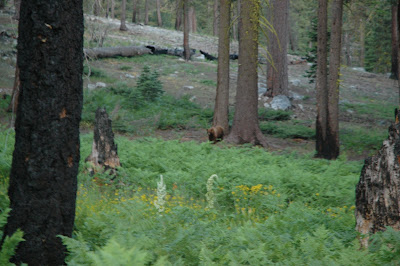
Here are my two best photos of the bears, shot from about 200 feet with a lens that only zooms to 70mm. (Sorry, I wasn't going to schlep a second lens on this trip!)

In the first one a cub is visible on a leafless tree left of center.


Here's the momma at the base of the two trees in the middle of the shot. An amazing sight!


Monday, August 1, 2011

Big Lil Loop, Day One

Epic. As far as I’m concerned, this was an epic trip, even if we were only in the backcountry for about 48 hours.

Our group on what was supposed to be the easiest of the overnight trips consisted of seven Marchers, including me, and our guides Heather and Mateo. The other Marchers were three dads and their kids, ages 7 to 11.

We spent Wednesday night at Hodgdon Meadow with the Marchers signed up for the Long Loop and our guides. There was rice pasta for dinner for those of us who don’t eat gluten. The next morning there were delicious lox and cream cheese along with Udi’s, the good gluten-free bread.


Thursday morning we were up around 6:30 getting ready for our respective trips. Most of us were at the dam ready to go around 10. It was already hot and we were about to climb nearly 3,000 feet on a rocky, exposed trail with our full packs.


Rattle snakes were a favorite topic that morning. I was anxious to spot one.

About half way up the switchbacks from the reservoir-side trail I asked a man coming down if had seen any. He said, “No, we saw some on our last trip, but not on this one. They try to stay out of your way.” A beat later he pointed and said, “There’s one!” Sure enough there was a long, fat one a couple feet down from the trail slithering into a gap between some rocks.


On one of our many stops Heather asked us to gauge how we were feeling with a thumbs-up, -sidways or –down. Mine was about half way between up and sideways. I had a headache, which is typical when I’m exerting myself in the sun on a hot day. But I was excited and wanted to keep my steady pace. There was lots to learn about my fellow marchers and from our guides.

We stopped for lunch at the top of the switchback trail, still a few miles of uphill from the site of a spring called Bee Hive. I ate a Ziploc baggie full of pasta and veggies left over from the night before. It hit the spot. We marched on.


It wasn’t long before, at a stop, I started to feel nauseated. I came back from using the natural facilities when everyone else was moving on and I told Heather how I was feeling.

In a few minutes I started throwing up. My stomach felt better. She asked me all kinds of questions about medications, how much I’d been drinking, if I could have the flu, if I could be pregnant. It was clear she knew how to handle the situation. Mateo came back down the trail a bit later to check on the situation, after the last hiker who left our little stop, Josh, told him I was feeling sick. He and Heather decided the rest of the group would go on and she and I would take our time.

I rested in the shade for a while, then we hiked a short distance back down the trail to a creek that made a little oasis, with gorgeous flowers all around. She filtered water with a hand pump and I soaked my clothes to get my core temperature down. Heather theorized that I had AMS (acute mountain sickness) or heat exhaustion, or a combination of the two. The cool water and rest made me feel somewhat better. I had an Emergen-C (sort of a Gatorade-powder drink) and a few nibbles of a gluten-free cereal bar.

We walked back to the packs and rested a bit more and started out again. We made a third or so of a mile before I puked again. We talked again about our options. There was a good spot to camp near there, and we could have stopped there and caught up the next day. We almost did, but she realized we had gear the other group need for dinner and they had gear we needed. If we could make it to Bee Hive with our packs, she could quickly cover the mile to the set campsite for the night, Laurel Lake, to exchange gear. After more rest, we pressed on.


I shuffled along for a little while, and she asked if I would do better without my pack. I said, “Sure, but what’s the alternative?” She offered to carry my pack. I was somewhat unbelieving that that was a real possibility and mumbled a noncommittal response. A short time later she said, “I’m going to carry your pack.” With her pack on her back, and mine on her front, we moved along slowly but steadily for almost two miles. It was getting to be 5 or 6 in the evening and with the sun no longer beating down, the break from carrying 25 pounds on my back was improving my condition greatly. The terrain was much easier, and my pace was just a tad faster than hers, me carrying only my camera and her toting 50 or more pounds of gear.

We came to another stream and filtered more water. I was feeling much better and ready to carry my pack again. We were nearly to Bee Hive when Heather said softly, “Look! Bears!” I could hardly believe my eyes. About 200 feet from the trail, across a level span of greenery, was a momma bear foraging while one of her cubs scampered up a tree after noticing us. The momma looked at us for a bit with a look that expressed mild interest. The baby looked down at her, clearly concerned. Soon we noticed another cub up a tree. And a half-blonde adolescent ambled up the hill, not seeming to notice us at all.

My only other bear experience was seeing one dash across the road while driving from Yosemite Valley to Wawona. So this sighting blew me away. It made the earlier nausea a distant memory.


We ogled the quartet as long as we dared in the fading light. After a few more minutes we arrived at Beehive, where we hoped to find our group. As we got attacked by mosquitoes, it became obvious why they decided to press on to Laurel Lake instead of camping at Beehive.

The signs at the junction were a bit sketchy, with one falling over a bit and the other directing toward a somewhat grown-over trail, but we soon noticed an arrow made with branches and highlighted with pieces of lichen! We eagerly followed. Soon there was a slightly-challenging stream crossing, which I made after Heather went across to find the trail.

We had one more climb before we came over a ridge and spotted campfire and headlamps. Heather hooted and got a reply to this from Mateo. It was almost totally dark, but we were finally able to relax. The cooler evening temps and the break afforded by Heather carrying my pack had contributed to what felt like a miraculous recovery.

Two headlamps came toward us and soon 7-year-old Xander was shouting at us: “You missed the most exciting thing!” Another momma bear and her two cubs had come right into camp soon after they got dinner going. Those had made their way out of camp without a confrontation, and the next day I saw amazing photos of the trio not 15 feet from the photographer (Jason). I think I would have been pretty nervous if bears had been that close to just Heather and me!

I made my way to the dinner area and my dear fellow Restore Hetch Hetchy board member Drew and his 9-year-old Dylan offered to put up my tent so I could rest and eat. I gratefully accepted. Miso soup plus a tortilla with a bit of avocado made a good dinner for my recovering stomach. I told some of my fellow marchers of our adventure and what an amazing nurse/sherpa/encourager my guide had been.